

Are you trapped in the “Discount Martyr” cycle? You see your overhead costs rising, yet you are paralyzed by the fear that a small price increase will send your loyal customers sprinting toward the competition. You want to move your price from $9.80 to $10.00, but you feel like you’re standing on the edge of a cliff. If this sounds like you, you aren’t just fighting a market battle—you are fighting a neurological one.
The Verdict: Price is a Perception, Not a Calculation
The core truth of neuromarketing is simple: Your customers do not perceive the difference between $9.80 and $10.00 as twenty cents. To the human brain, crossing that round-number threshold is a “Tier Shift.”
By understanding the Left Digit Effect, you can raise your prices while actually reducing the psychological friction your customers feel. At Sparkle and Innovation, we combine psychology and brain science to ensure your value reaches the right fans without sacrificing your bottom line.
The Foundation: How the Brain Encodes Magnitude
To understand why the “9” in $9.99 is so powerful, we must look at how the brain processes information. Humans are “Cognitive Misers”—our brains are biologically wired to be lazy and seek shortcuts to save energy.
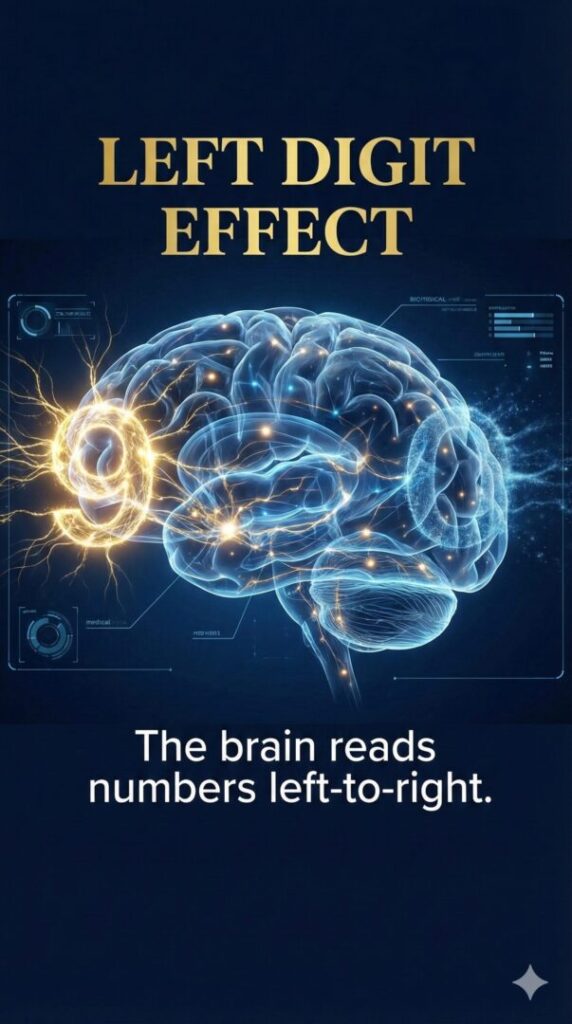
When we see a price, our eyes scan from left to right. Because the brain encodes magnitude immediately, the first digit we see acts as a “Primary Anchor.” This happens in milliseconds, long before the rational part of the brain can perform a subtraction exercise. This is a fundamental aspect of behavioral economics that every business owner must master to avoid being undervalued.
The relationship between numbers and buying behaviour is structured by Structural Encoding. When a consumer sees $9.80, the brain categorises it into the “9-something” tier. The moment that first digit changes to “1”, the brain shifts the item into an entirely different mental bucket: “10-something.”

The Knowledge: Breaking the Left Digit Effect
The Left Digit Effect suggests that the perceived difference between $2.99 and $3.00 is significantly larger than the difference between $3.24 and $3.25. This occurs because the leftmost digit anchors the magnitude.
At Sparkle and Innovation, we emphasize Investigation and Optimization. We don’t just guess; we analyse how your specific customer base reacts to these anchors. For a deeper look at our scientific approach to market research, you can explore our Philosophy of Investigation and Optimisation.
The Paradox: “Aren’t Customers Smarter Than This?”
There is a common counter-argument: “In the age of information, customers are rational. They know $9.99 is basically $10.00. Using ‘charm pricing’ makes my brand look cheap and manipulative.” This sounds logical, but it ignores the reality of subconscious triggers. Even highly educated consumers are subject to these biases because they occur in the amygdala and the ventral striatum before the prefrontal cortex (the rational part of the brain) can intervene.
The Rebuttal: Subconscious Reflex vs. Conscious Logic
While your customers are indeed smart, their Fast Thinking (as defined by Daniel Kahneman) is what drives the initial “stop or go” decision in a purchase. You aren’t “tricking” them; you are aligning your pricing with the natural way the human eye and brain communicate.
In fact, the Journal of Consumer Research has published extensive peer-reviewed studies proving that the left-digit effect persists even when consumers are aware of the tactic. You can find detailed academic insights into numerical cognition through the National Institutes of Health (NIH) database here: https://www.ncbi.nlm.nih.gov/pmc/articles/PMC3584580/.
Case Study: The 20-Cent Battle
Imagine a high-end cafe bill.
Scenario A: The bill is $10.00. The customer feels they have entered the “double-digit” territory for a single lunch item.
Scenario B: The bill is $9.80.
Even though the difference is a mere 20 cents, the “9” creates a “bargain” signal. We recently worked with a client in the B2C sector who feared raising their subscription from $45 to $50. By reframing the price to $49.90, they maintained their conversion rate while increasing their profit margin by 10%. They didn’t just provide a product; they provided a “reason” for the brain to say “Yes.”
Would you like me to analyze your current pricing list to identify any “Left Digit” risks?
Contact us if you are interested!
Raising prices is a necessity for growth, but doing it without a psychological strategy is a risk.
-
Respect the Anchor: The leftmost digit is your most powerful tool.
-
Tier Management: Stay within the lower tier (e.g., $9.95) to keep the “magnitude” signal low.
-
Education is Key: Understanding why your customers buy is the first step to innovating your business.
“Redesign your Business | Deliver your Value”
If you’re ready to stop guessing and start using science to scale, check out our Tailormade Pricing Plans, where we calculate backwards from your goals to find the optimal strategy.
Next week, we dismantle the Decoy Effect: “Why Only the ‘Middle’ Option Sells.”
If you think today’s topic was shocking, next week’s will change your entire business model.

Would you like me to analyze your current pricing list to identify any “Left Digit” risks?
Contact us if you are interested!