
If you’ve ever found yourself opting for a medium coffee just because the large seemed a bit too expensive and the small felt inadequate, you aren’t alone.
You were gently guided by one of the most powerful psychological tools in a marketer’s arsenal: The Decoy Effect.
At Sparkle and Innovation, I spend my days analyzing the exact brain patterns that trigger consumer purchases. What I have found repeatedly is that many businesses bleed revenue not because their products are poor, but because the architecture of their choices is fundamentally flawed. When customers face too many choices without clear relative value, they suffer from the Paradox of Choice and abandon the transaction entirely.
Here is the exact neuroscience of why introducing a “Decoy” can instantly multiply your core product’s sales, and how you can apply it to your menu or pricing design today.
The Neuroscience of Relative Value
Human beings are remarkably bad at determining the absolute value of a standalone item. If I hand you a beautifully crafted ceramic mug and ask, “Is this worth $45?” your brain struggles. It lacks context.
However, our brains are exceptionally fast at comparing things. As noted in behavioral research surrounding cognitive biases, the brain relies on heuristics—mental shortcuts—to make decisions without burning excessive caloric energy.
When you introduce a third, less attractive option (the decoy) into a set of two choices, it completely alters the perceived value of the original two. According to studies on human decision-making highlighted by the American Psychological Association (APA), asymmetric dominance (the academic term for the decoy effect) shifts preferences reliably toward the target item.
The Paradox: More Choices Do NOT Equal More Sales
A common misconception I hear from business owners is, “I want to give my customers exactly what they want, so I’ll offer 20 different variations.”
This is a fatal error.
When a consumer is faced with 20 options, the cognitive load is immense. The fear of making the “wrong” choice overshadows the joy of making a purchase. Instead of buying, they say, “Let me think about it,” and leave.
To drive sales, you must constrain choice and provide a clear, logical winner.
The Sushi Menu Application: Designing for the Brain
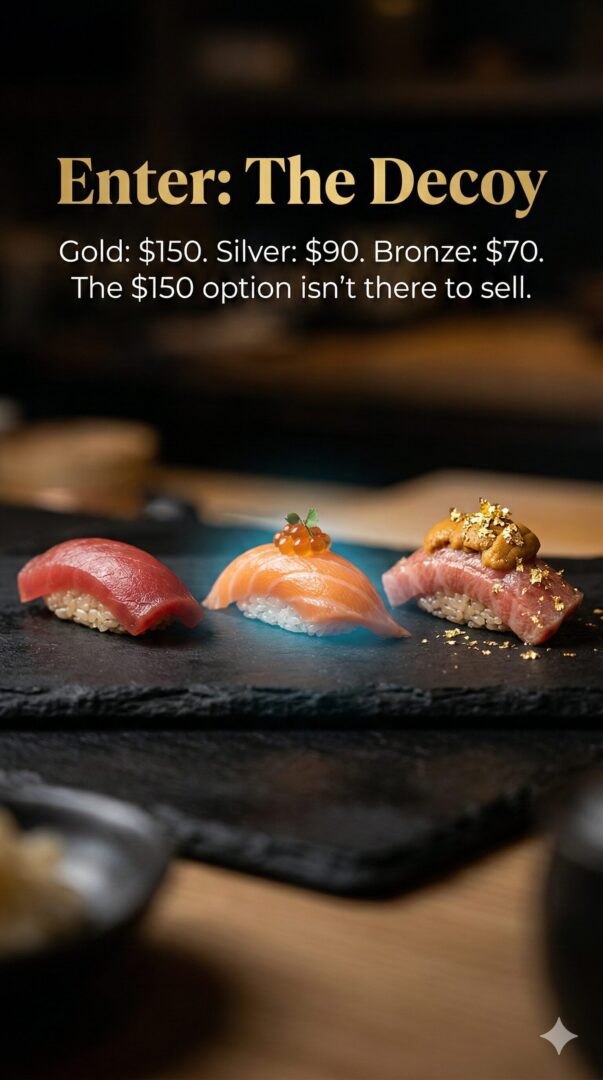
Let’s look at the classic high-end sushi omakase menu:
Gold Omakase: $150
Silver Omakase: $90
Bronze Omakase: $70
If the menu only had the $90 and $70 options, many consumers would instinctively pick the $70 option to save money. The $90 option feels like a splurge.
But when you add the $150 “Gold” option—the decoy—the psychological math changes. The $150 option anchors the high end of the scale. Suddenly, the $90 “Silver” option no longer looks like a splurge; it looks like a high-quality compromise. You aren’t being cheap (avoiding the Bronze), and you aren’t being reckless (avoiding the Gold). You are making a “smart” choice.
The restaurant doesn’t actually expect to sell many $150 dinners. The Gold tier exists purely to make the Silver tier irresistible. Research spanning decades, including pivotal works often cited by institutions like Harvard University’s Program on Negotiation, confirms that anchoring significantly impacts economic negotiations and pricing perception.
How to Implement This Today
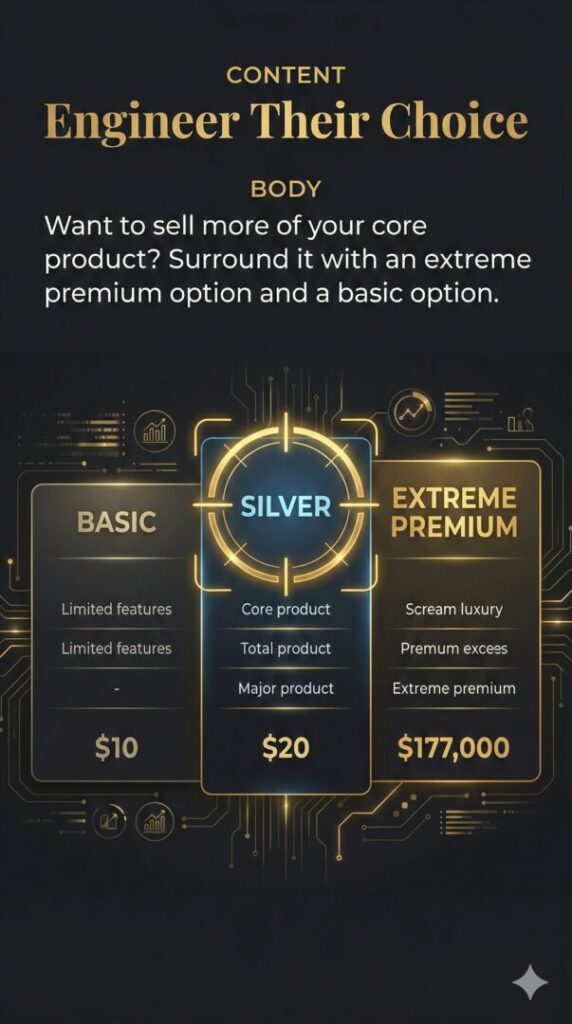
Identify Your Target: Determine the exact product or package you want to sell the most (e.g., your $90 service).
Create the Decoy: Build a premium tier above your target that is significantly more expensive but only marginally better in features (e.g., a $150 service).
Establish the Floor: Offer a basic tier below your target (e.g., $70) to capture price-sensitive buyers, but make it clearly inferior to the middle tier.
Highlight the Middle: Visually draw attention to the middle option using design cues—a glowing border, a “Most Popular” tag, or central placement.
Summary
Pricing isn’t about math; it’s about context. By utilizing the Decoy Effect, you remove the friction of choice and provide your customers with a subconscious justification to buy your most profitable offering. Stop overwhelming them, and start guiding them.
Ready to dive deeper into the rabbit hole of pricing psychology? Next week, we will shatter everything you know about luxury branding in our next breakdown: Why a $5,000 Bag Looks Cheap.