

For the first two years, the phone just rings. A happy client tells a friend, the friend tells a colleague, and the calendar fills itself. Then one big client leaves, two referrals fall through in the same month, and the order board goes quiet. The owner finally hires a marketer and expects new sales by next month. Instead, the first quarter disappears into building a website that works, a list that does not exist yet and a reputation that nobody outside the referral circle has heard of.
If that sounds familiar, you are asking the right question too late. This guide answers when to hire a marketer for a small or mid-sized business, using an illustrative model case (not a client result), the research on how buyers actually choose, and a simple trigger you can set today.
When to Hire a Marketer: The Short Answer
Hire, or contract, marketing help while you are still busy enough not to feel the need. That sounds backwards, but it matches how demand works. Marketing that starts in a crisis is trying to catch the few buyers who happen to be ready this month. Marketing that starts early is building memory with everyone who will be ready next year.
In practice, most owners do better with a trigger than with a feeling. A feeling arrives late. A trigger arrives on time.
Why Referral-Only Growth Stalls
Referrals are the best leads most service businesses ever get. They arrive warm, trust you already and rarely haggle. The problem is not quality. It is control. You cannot turn referrals up when you need them, and you cannot see them coming.
- They are lumpy. A few clients send most of the work, so losing one hurts more than it should.
- They are invisible. You do not know who is about to refer you, so you cannot plan around it.
- They cap your reach. Your next client has to know one of your current clients. Everyone else never hears your name.
Referrals are worth designing on purpose, and our guide to building a referral program for small business shows how. But a business that runs on referrals alone is one quiet quarter away from a panic hire.
The Psychology: Most Buyers Are Not Buying Yet
Professor John Dawes of the Ehrenberg-Bass Institute estimated that only about 5% of B2B buyers are in the market for a given product or service in any quarter. The other 95% will buy later. Researchers call this the 95:5 rule, and it was popularized by the LinkedIn B2B Institute.
Why does that matter for hiring? Because people rarely start a search from zero. When the need finally arrives, they shortlist the names that come to mind first. Psychologists call it availability: what is easy to recall feels like the safe, obvious choice. A marketer hired in a crisis spends their first months chasing the 5% who are ready now, while the memory-building work with the other 95% should already have been running.

In plain English: you are marketing to next year’s buyers, not just this month’s.
Model Case: The Firm That Hired Too Late
Picture an illustrative engineering consultancy of eight people in the Lower Mainland. For three years, two long-standing clients and their referrals keep everyone busy. There is a basic website, no email list and no regular content. Nobody has time, and nobody feels the need.
Then one of the two anchor clients restructures and pauses projects. Within six weeks the team has gaps on the schedule. The owner contracts a marketer and asks for leads within thirty days.
The marketer finds that there is nothing to build on. The website does not explain who the firm serves. There is no list of past enquiries to reconnect with. The firm does not show up for the searches buyers make. So the first ninety days go into foundations, the gap on the schedule gets wider, and the owner starts to doubt marketing itself.
Now run the same firm with one change: it started a modest, steady marketing effort eighteen months earlier, while both anchor clients were still active. When the restructure hits, there is a list of past contacts to email, a few useful articles that rank for real questions, and a name that prospects already recognise. The gap still hurts, but it is a dip, not a cliff.
Three Signs It Is Time to Hire a Marketer
You do not need all three. One is enough to start planning.
- Referrals are more than half of new revenue. Concentration is risk. If one source dried up, how long would your pipeline last?
- You cannot answer where your next ten clients come from. If the honest answer is “the usual people,” you are depending on luck you cannot see.
- You are about to add capacity. A new hire, a new location or a new service needs demand that does not exist yet. Start building it before the cost arrives.
Knowing what a customer is worth over time makes this decision easier. If you have not worked it out, start with our guide to customer lifetime value.
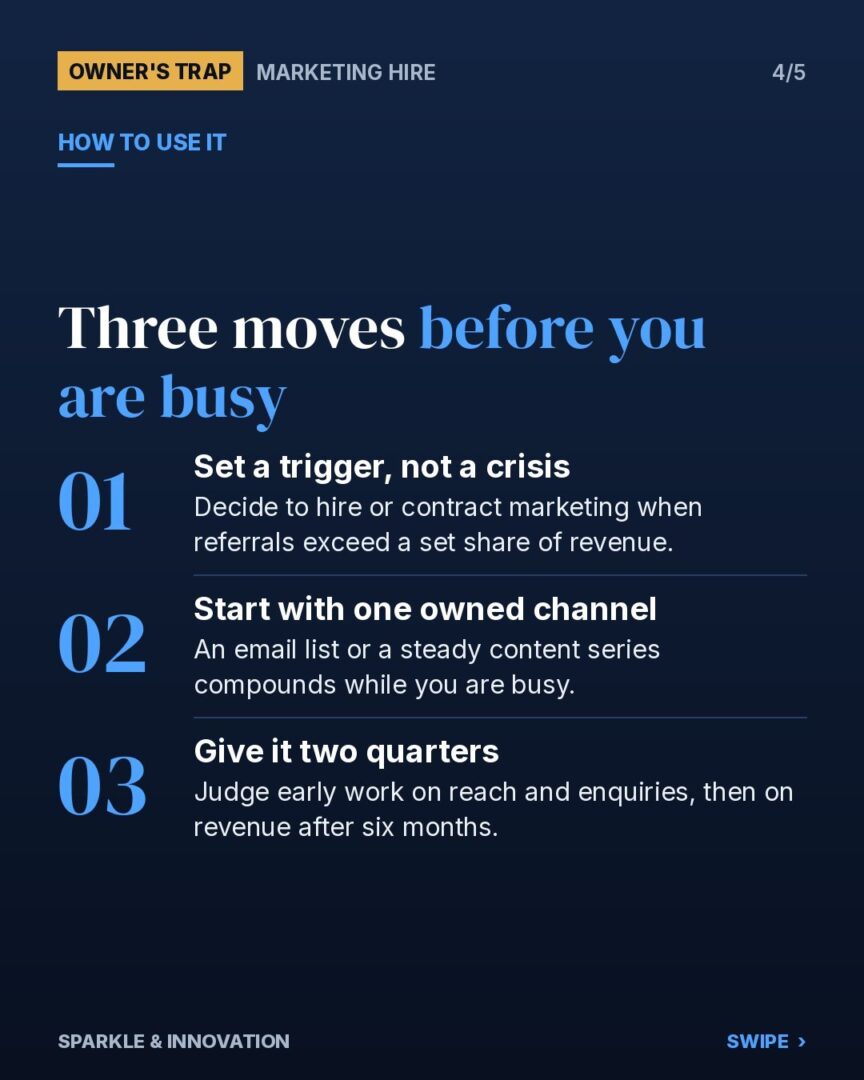
Set a Trigger, Not a Crisis
The most useful move is to decide now, in writing, what will make you hire. Examples:
- “When referrals are above 60% of new revenue for two quarters, we contract marketing help.”
- “When we commit to a new hire, we start a marketing budget the same month.”
- “When our top client is more than 30% of revenue, we start building a second source of demand.”
A trigger turns a vague worry into a scheduled decision. It also protects you from the moment when you are too busy to think about marketing and too worried to wait.
Start With One Owned Channel
You do not need a full department on day one. You need one channel that you own and that compounds while you are busy.
- An email list. Every enquiry, past client and event contact, with one useful note a month.
- A steady content series. One clear answer to one real buyer question, published on a schedule. Our marketing and SEO guide explains how this builds search visibility over time.
- Your local presence. For local service firms, a complete Google Business Profile is often the fastest win. See how a local plumber uses MEO (map engine optimization) to become the first call.
Give It Two Quarters Before You Judge It
Early marketing builds memory before it builds revenue. Judge it in stages:
- Months one to three: reach and activity. Are the right people seeing you? Is the list growing?
- Months four to six: enquiries. Are new conversations starting from sources other than referrals?
- Month six onward: revenue and cost per new client.
Keeping existing clients is part of the same picture. Our comparison of customer retention vs acquisition cost shows why the two work together.
The Catch: When Hiring a Marketer Backfires
The 95:5 rule is not a reason to spend without limits or to stop measuring. The common shortcut is to hire someone, hand them a vague goal like “get our name out there,” and then either judge them on sales in month one or never judge them at all. Both fail. The first burns out a good marketer before the work can pay off. The second lets money drift into activity that nobody can link to results.
The other shortcut is to fill the silence with volume: daily posts, generic ads and pushy follow-ups to every contact you have. People notice when a business that was quiet suddenly shouts, and pressure in a sales follow-up tends to cost more goodwill than it wins.
Do it right: start early, start small, set clear stage-by-stage measures, and choose helpful, consistent marketing over loud, sudden marketing.
Frequently Asked Questions
Should my first marketing hire be full-time or a contractor?
For most small firms, a contractor or agency for six to twelve months is a lower-risk start. It lets you learn which channels work before you build a role around them.
How much should a small business spend on marketing?
There is no single right number. Start from what a new client is worth to you over time and how many new clients you need, then work back to a budget you can sustain for at least two quarters.
What if we are already in the quiet period?
Start now, but split the effort: reconnect with past clients and enquiries for short-term work, and begin the long-term memory building at the same time.
Key Takeaway
The best time to hire a marketer is before you need one. Most buyers are not ready this quarter, and when they are, they choose the names they remember. Set a trigger, start one owned channel and give it two quarters, so you are remembered when buyers are ready.
Not Sure If It Is Time?
We can help you check where your next ten clients will come from. Contact Sparkle & Innovation and ask for a free 15-minute marketing audit, or DM us “AUDIT” on Instagram.