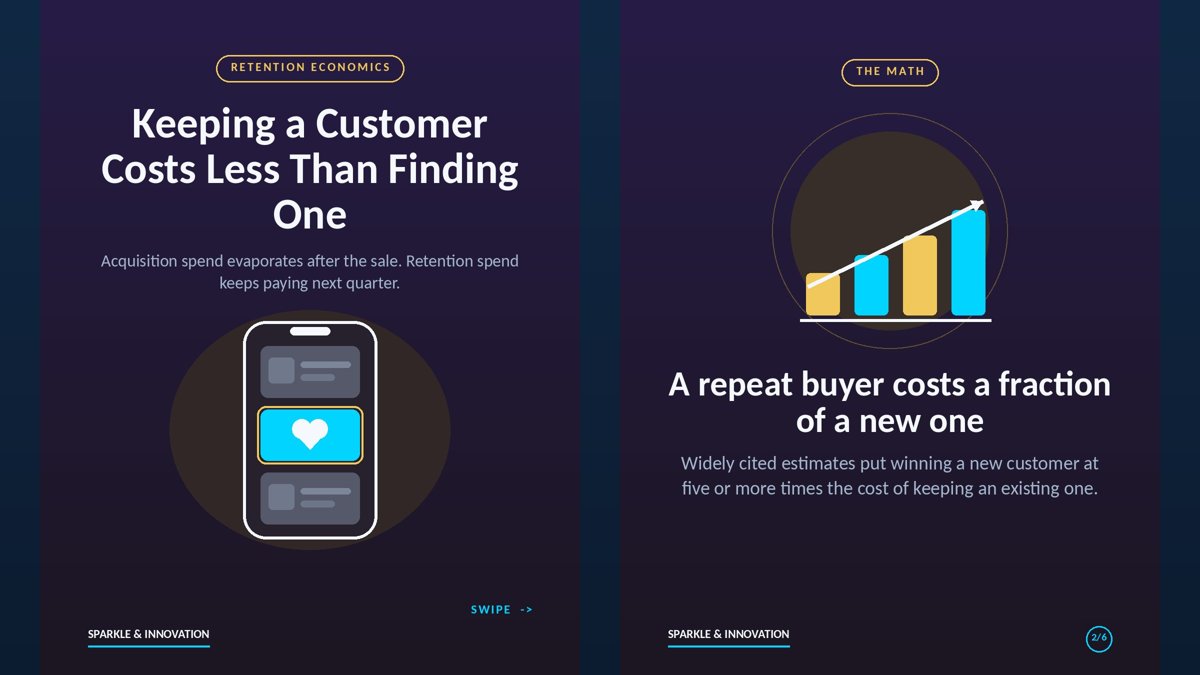

Customer retention vs acquisition cost is the comparison most growth plans never make, and it decides whether growth is real or just expensive. Every business tracks how many new customers it wins. Far fewer track how many it quietly loses, or what each of those two numbers actually cost to produce. When you put them side by side, the picture changes: the customer you already have is almost always the cheapest revenue in the building.
This article walks through why retention costs less, where the numbers come from, what the human brain has to do with it, and three retention moves a small or mid-sized business can put in place this quarter.
What the customer retention vs acquisition cost comparison actually measures
Customer acquisition cost (CAC) is everything you spend to turn a stranger into a paying customer, divided by the number of customers you won. Media, content, sales salaries, tools, discounts on the first order, agency fees. If you spent $20,000 last quarter and won 40 customers, your CAC is $500.
Retention cost is everything you spend to keep an existing customer buying: onboarding, account management, check-ins, loyalty offers, support. It is rarely measured on its own because it hides inside operations rather than marketing, which is exactly why it gets underfunded.
The comparison is simple: what does it cost to produce one more dollar of revenue from a new customer versus from a customer you already have? The widely cited estimate is that acquiring a new customer costs five or more times what it takes to retain an existing one. The exact multiple depends on the industry and the sales cycle, but the direction is remarkably consistent across sectors, and the research behind it is not new. Frederick Reichheld’s work, summarized in the Harvard Business Review, found that small improvements in retention rates produce disproportionately large improvements in profit.
Why a returning customer costs less: trust already built is cost already paid
The economics follow directly from how people make buying decisions. A stranger has to be moved through a sequence of stages before they will pay you: they have to notice you, understand what you do, believe you can do it, decide you are better than the alternatives, and overcome the doubt that comes with any first purchase. Every one of those stages has a price tag. Awareness costs media. Understanding costs content. Belief costs proof, reviews and case studies. Overcoming doubt costs discounts, guarantees and sales time.
A returning customer has already been through all of it. They know who you are. They have seen the product work. The trust is built, and the money that built it has already been spent. When they buy again, you are collecting a return on an investment you made last year, not making a new one.
This is the same reason follow-up outperforms first contact in sales: each touchpoint compounds on the ones before it. Acquisition resets the counter to zero with every stranger. Retention keeps counting.
The brain science: familiarity, loss aversion and the status quo
Three well-documented patterns in human decision-making explain why retention is structurally cheaper.
Familiarity feels safe. The mere exposure effect, first demonstrated by Robert Zajonc in 1968, shows that people rate things more positively simply because they have encountered them before. A customer who has used your service for a year processes your brand with almost no effort, and the brain interprets that ease as trustworthiness. A competitor has to earn what you get for free.
Switching feels like a loss. Prospect theory, developed by Kahneman and Tversky, shows that losses loom roughly twice as large as equivalent gains. Once a customer has a working relationship with you, leaving means giving something up, and the brain weighs that loss heavily. This is the same force behind the endowment effect: people value what they already hold more than what they could acquire.
Defaults win. Changing suppliers takes effort: research, comparison, onboarding, risk. The status quo is the path of least resistance. An existing customer will stay unless something pushes them out. A prospect will not move unless something pulls them in. Pushing costs less than pulling, which means the cheapest retention strategy is often just not giving anyone a reason to leave.
The leak nobody reports: how churn erases growth
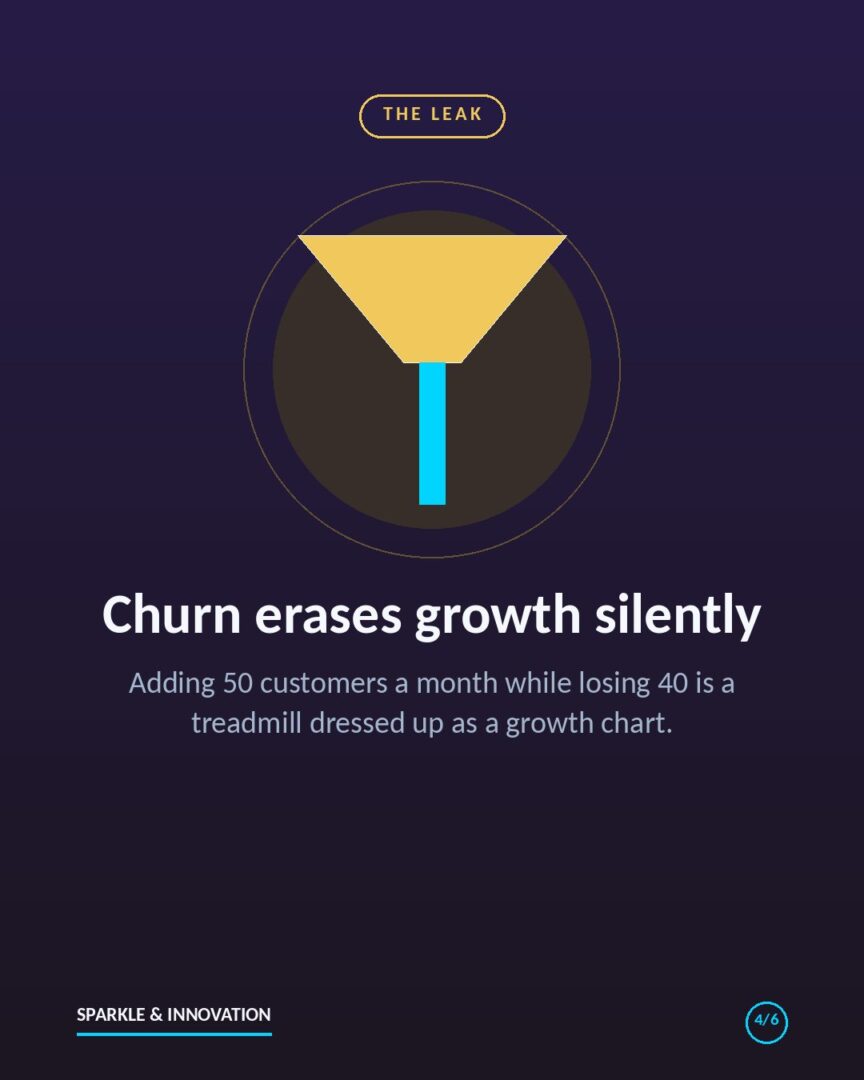
Here is the pattern that plays out in a lot of businesses. New-customer numbers are reported weekly, celebrated in the team meeting and tied to bonuses. Churn is reported quarterly, if at all, usually to finance rather than to marketing. The result is a company adding 50 customers a month while losing 40, looking at a rising sales chart and wondering why the bank balance is flat.
The arithmetic is unforgiving. If you gain 50 and lose 40, net growth is 10 customers a month, but you paid acquisition cost on all 50. At a $500 CAC that is $25,000 spent to net 10 customers, an effective cost of $2,500 per net new customer. Cut churn from 40 to 20 and the same $25,000 nets 30 customers at $833 each. Nothing about the acquisition machine changed. The leak was patched.
This is why the churn rate belongs on the same page as new sales, reviewed at the same meeting, by the same people. When the two numbers sit side by side, retention stops being an operations afterthought and becomes a marketing decision.
Where retention spend produces the highest return
Not all retention spending is equal. The highest-return moments are the ones where a customer is deciding, consciously or not, whether the relationship is worth continuing. There are three of them in almost every business.
- The first week. A new customer who has not yet seen a result is still evaluating. Cancellation is a live option until they can point to something the product did for them.
- The quiet middle. Between purchases, most dissatisfaction is silent. Customers rarely complain before they leave; they simply stop responding. Whoever notices first keeps the customer.
- The next-purchase moment. A customer with nothing obvious to buy next drifts. The ones who stay are the ones who always have a reason to come back.
Spending in these three windows produces a measurable return inside a quarter. Spending outside them, on generic loyalty points or brand-building to existing customers, usually does not.
Three retention moves that pay this quarter
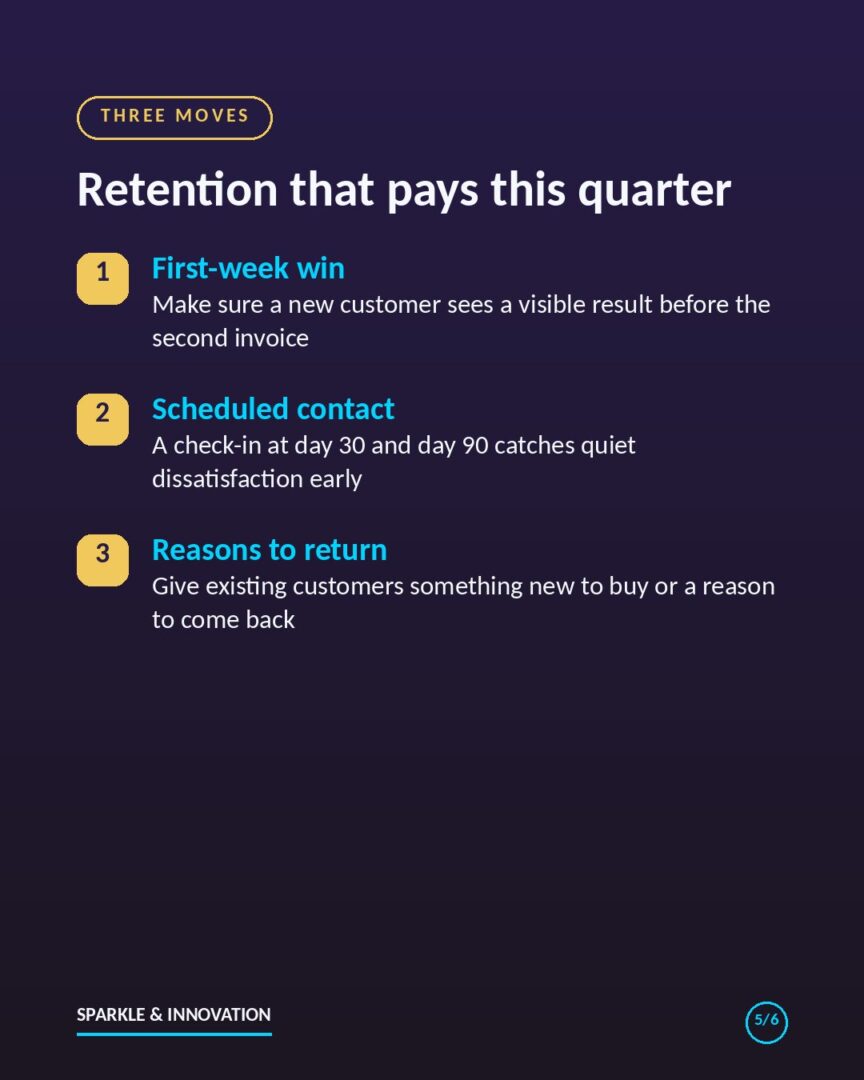
1. Engineer a first-week win
Design the first seven days so the new customer sees a concrete result before the second invoice. For a software product, that means one completed workflow, not a feature tour. For a service, it means a visible deliverable or a quick fix to the problem they hired you for. For a physical product, it means a follow-up that helps them use it correctly. The moment a customer can point to a result is the moment cancellation stops being a live option. A structured customer onboarding process is the most reliable way to make that moment happen on schedule.
2. Schedule human contact at day 30 and day 90
A check-in from a real person, not an automated survey, at day 30 and again at day 90 catches quiet dissatisfaction while it is still fixable. The script is short: what is working, what is not, what would make this more useful. Most churn is silent until the cancellation email, and these two conversations are the only reliable way to hear it early. They also surface expansion opportunities that no dashboard would show.
3. Give existing customers a reason to return
Every customer should always have a next step in front of them: a complementary service, a seasonal reminder, a new tier, a related product. This is not upselling for its own sake; it is removing the drift that happens when a relationship has no forward motion. The reason to return should be specific to what they already bought, sent at the moment it becomes relevant, and easy to act on.
How to fund it: the 20 percent test
The practical budget move is a two-quarter experiment. Take 20 percent of the current acquisition budget and redirect it to the three moves above: onboarding design, check-in time and next-step offers. Track two numbers for each budget: revenue produced and cost to produce it. In most businesses the retained dollars win, because they are spent on people you already understand, who already trust you, and who do not need to be convinced from scratch.
If you are unsure how much to move, start by calculating what each customer is worth over their lifetime. Once you understand the full value of a B2B relationship, the case for protecting it usually makes itself.
Common mistakes when comparing retention and acquisition
Counting retention as free. Onboarding, account management and support are real costs. If they are not measured, retention looks cheaper than it is, and the comparison loses credibility with finance.
Retaining the wrong customers. Some customers cost more to serve than they pay. Retention effort should go to customers with healthy margins and growth potential, not to everyone equally.
Treating churn as a support problem. Churn is usually decided by expectations set during acquisition. If marketing promises something the product does not deliver, no amount of retention spend will fix it. The two functions have to share the number.
Stopping acquisition. Retention lowers the cost of growth; it does not replace new customers. Every customer base shrinks eventually. The goal is a balanced budget, not a swap.
The takeaway
Every dollar of acquisition buys a chance. Every dollar of retention buys a customer you already understand. The customer retention vs acquisition cost comparison does not argue for abandoning growth; it argues for measuring both sides of it, funding the cheaper side properly, and putting churn on the same report as new sales so the whole company sees the leak at the same time.
Start this week: pull last quarter’s new-customer count and the number of customers who stopped buying in the same period. Put them on one page. If the second number surprises anyone, the retention budget just found its justification.
Want a second opinion on where your acquisition budget is leaking? Get in touch with Sparkle & Innovation and we will walk through the numbers with you.
Marketing starts with understanding the human brain. – Sparkle & Innovation