
Scarcity marketing is the practice of signalling that something is limited, in quantity, in time, or in access, so that people decide sooner. It is one of the oldest levers in persuasion and one of the most reliable, because it does not depend on the product being better. It depends on how the brain treats things that might disappear.
It is also one of the most abused. Countdown timers that restart when you refresh the page. “Only 3 rooms left” banners that say the same thing next week. Sales that end every Sunday and begin again every Monday. These tactics borrow the psychology of scarcity without the substance, and the bill arrives later: lost trust, refund requests, one-star reviews that mention the trick by name, and in a growing number of jurisdictions, regulatory attention.
This guide explains why scarcity marketing works, where it breaks, and how a small or mid-sized business can use it in a way that speeds up decisions without spending down the trust it has earned.
Why scarcity marketing works: the brain reads availability as value
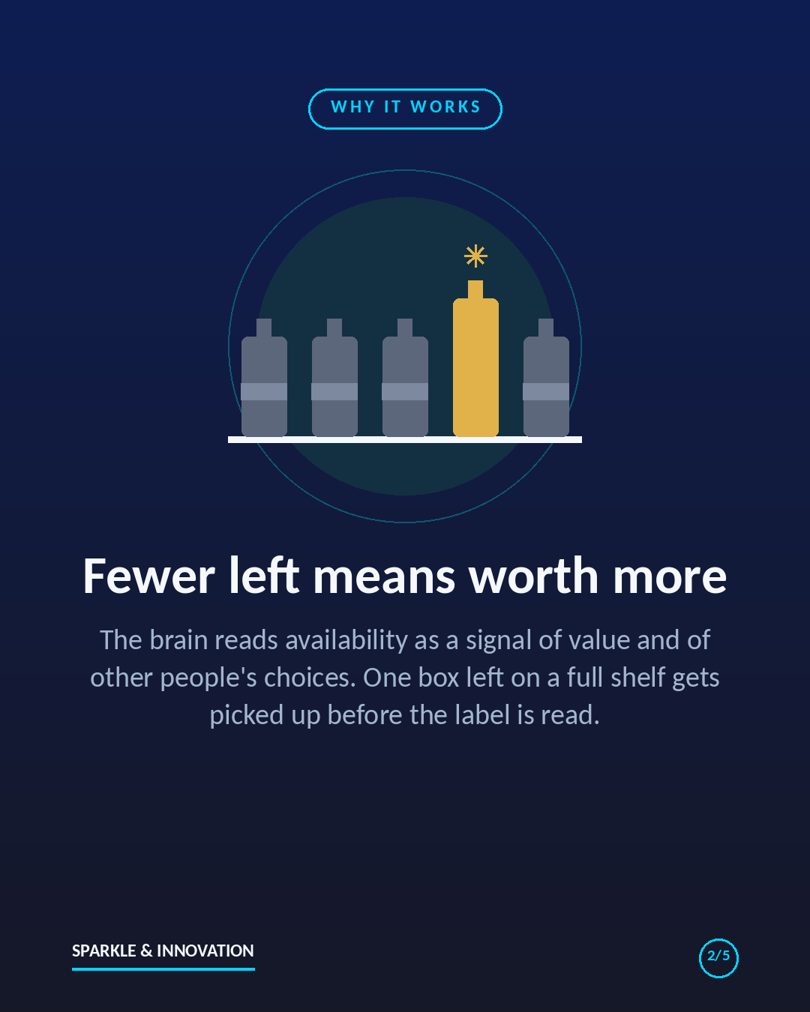
When a product is nearly gone, the brain infers two things at once. First, it must be valuable, because valuable things get taken. Second, other people have already chosen it, which is a form of social proof. Neither inference requires conscious thought. That is what makes the cue powerful: it changes how the product is evaluated before the evaluation starts.
A classic demonstration comes from a 1975 study by Stephen Worchel and colleagues. Participants rated cookies from a jar holding ten cookies and from a jar holding two. The cookies were identical. The ones from the nearly empty jar were rated as more desirable, and the effect grew when participants were told the jar had started full and been emptied by other people. Scarcity made the cookie look better. Scarcity caused by other people’s choices made it look better still.
Robert Cialdini later listed scarcity as one of the core principles of influence, and the reasoning connects directly to loss aversion. Losing an option feels worse than gaining an equivalent one feels good. When a buyer believes the chance to buy may vanish, the decision reframes from “do I want this?” to “am I willing to lose this?” The second question is far easier to answer with yes.
The three kinds of scarcity, and which one your business actually has
Most discussions of scarcity marketing treat it as one tactic. In practice there are three distinct types, and the honest ones map onto how a business really operates.
- Quantity scarcity. There are a limited number of units. Small production batches, a fixed cohort size for a course, a set number of appointment slots per week. This is the most credible form because it is easy to verify and easy to explain.
- Time scarcity. The offer is available until a date. Early-bird pricing, seasonal products, a launch window. Credible when the date is real and the offer genuinely changes afterward.
- Access scarcity. Not everyone can buy. Waitlists, members-only releases, invitation-only tiers. Credible when the restriction has a reason the buyer can understand, such as onboarding capacity or a community that depends on fit.
The useful exercise is to ask which of these your business has for structural reasons. A physiotherapy clinic has real quantity scarcity: a finite number of therapist hours per week. A roaster has real time scarcity: beans roasted on Tuesday are at their best for a limited window. A consultancy has real access scarcity: it can onboard only so many clients per quarter without quality falling. Scarcity claims built on these facts survive scrutiny because they are true, and because the reason behind them is something a customer would find reasonable if they asked.
Where scarcity marketing breaks: the reset timer problem
The same brain circuitry that makes real scarcity persuasive makes fake scarcity expensive. Once a buyer detects that a limit was fabricated, two things happen. The immediate purchase decision is discounted, which is the obvious cost. The less obvious cost is that every future claim from that brand is discounted too, because the brain has now filed the source as unreliable. Trust, once a shortcut, becomes a verification step.
The failure patterns are well known:
- A countdown timer that resets on refresh or on a new session.
- A stock counter that never changes, or that changes only downward until the page is reloaded.
- “Sale ends tonight” repeated every night.
- “Limited seats” for a webinar that is recorded and replayed indefinitely.
- Waitlists that admit everyone the moment they sign up.
These are no longer only reputational risks. In the United States, the Federal Trade Commission has explicitly described false urgency, including fake countdown timers and misleading low-stock messages, as a “dark pattern” that can violate consumer protection law, and has taken enforcement action on that basis. Similar guidance exists in the UK and the EU. A tactic that a marketing plugin can switch on in thirty seconds can now generate a regulator’s letter.
Scarcity and social proof: the combination that does the work
Worchel’s cookie jar finding contains a detail worth keeping. Scarcity alone raised desirability. Scarcity caused by demand raised it more. “Only 4 left” is a stronger message than “limited edition” because it implies that other people have been buying, and the brain uses other people’s choices as evidence.
This is why the most effective scarcity messages report a fact about demand rather than a decision about supply. “40 seats. 27 taken.” tells the reader three things: the cap is real, most of it is gone, and it is going because other people chose it. “Limited availability” tells the reader nothing verifiable and invites suspicion. The specific version is also easier to keep honest, because it is tied to a number you have to update.
How to use scarcity marketing without burning trust
The rule that separates useful scarcity from damaging scarcity is simple: the claim must be true because of how the business works, not because a tool says so. Everything below follows from that.
1. Make the limit structural
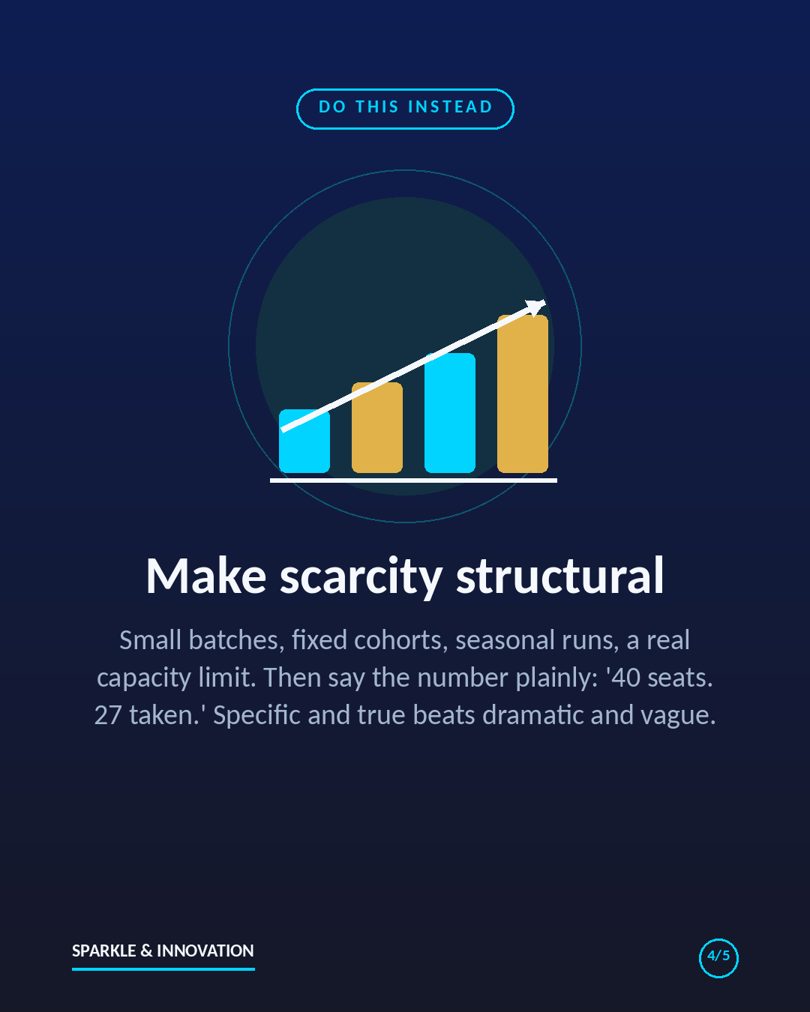
Set the limit where it really exists. If you can serve twelve clients a month, say twelve. If a batch is 200 units, say 200. If early pricing ends on the 30th, end it on the 30th. If there is no real limit, do not invent one; use a different lever, such as a clear guarantee or a well-designed pricing structure.
2. State the number, not the adjective
Replace “limited” with the count. Replace “ending soon” with the date and time. Replace “high demand” with the number taken. Specific numbers are more persuasive and easier to keep accurate. They also signal that you expect to be checked, which itself builds trust.
3. Let it run out in public
When the batch sells out, show “sold out” and the date the next batch opens. This is where fake scarcity operators lose their nerve, because a sold-out page feels like lost revenue. It is the opposite. A visible sellout is proof that the limit was real, which makes the next launch’s scarcity claim credible before you make it. It also builds a waitlist, which converts far better than cold traffic.
4. Give the reason
A limit with a reason reads as a fact. A limit without one reads as a tactic. “We roast on Tuesdays and ship the same day, so each week’s run is capped at what we can roast” explains quantity scarcity in one sentence and turns it into a quality signal. “We take on six new clients a quarter so that each one gets a senior lead” does the same for access scarcity and supports a premium price, which connects to how you raise prices without losing customers.
5. Pair scarcity with certainty
Scarcity accelerates the decision; it does not remove the risk of a wrong decision. A buyer being asked to decide now will decide faster if the downside is capped. A clear refund window, a trial period, or a specific guarantee removes the objection that urgency creates. The two levers work best together: the limit says “decide now,” the guarantee says “you are safe to.”
Scarcity marketing examples that hold up
Here is how the principle looks in businesses that are not selling sneakers or concert tickets.
- A bakery posts the morning’s batch count at 6 a.m. and marks items sold out on its site as they go. Regulars learn to order early. The scarcity is real every day, and the sellout notices become the marketing.
- A course creator runs cohorts of 30 with a fixed start date. The enrolment page shows seats taken. When 30 is reached, the page switches to a waitlist for the next cohort. No timers, no extensions.
- A B2B agency publishes its onboarding capacity: four new clients per quarter. Prospects who miss the window are offered a smaller diagnostic engagement in the meantime. The cap is a fact about staffing, and it is stated as one.
- A clinic lists next-available appointment dates rather than “book now.” When the next slot is eleven days out, that fact does more than any urgency banner could.
In each case, the scarcity message could be screenshotted a week apart and still be consistent with reality. That is the test.
A ten-minute audit for your own site
Open your website and your last three email campaigns. List every timer, every stock counter, and every phrase such as “limited,” “ending soon,” “last chance,” or “only a few left.” For each one, answer three questions:
- Is this limit true because of how the business operates?
- Could a customer verify it, or at least understand the reason for it?
- Would two screenshots taken a week apart be consistent?
Anything that fails one of the three should be rewritten as a specific, true statement or removed. In most audits we run, roughly half the urgency language on a small business site cannot pass the third question. Removing it rarely lowers conversion, because the language was already being discounted by readers. Replacing it with a true number usually raises conversion, because the number is believed.
The takeaway
Scarcity marketing is a trust loan. A real limit borrows a little of the customer’s trust and pays it back immediately with a faster, more confident decision. A fake limit borrows the same trust and defaults on it, in public, at the moment the customer notices. The tactics that work over years are the ones built on constraints your business actually has: batches you actually make, seats you actually fill, dates that actually pass. Find those constraints, state them as numbers, and let the sellouts do the talking.
If you want a second pair of eyes on the urgency language across your site and email, we do a short scarcity and trust review as part of our marketing diagnostics. Send us the URL and we will tell you which claims are helping, which are being ignored, and which ones are quietly costing you the next sale.
Marketing starts with understanding the human brain. Sparkle & Innovation.