
A sales follow-up strategy is the least glamorous part of B2B growth and the most profitable one to fix. Ask any team where their deals die and they will point to the pitch, the pricing, or the competitor. Look at the pipeline data and a quieter pattern appears: the buyer was still deciding when the seller stopped showing up.
This article covers the gap between when buyers decide and when sellers give up, the brain science that makes repeated contact persuasive rather than irritating, a five-touch cadence you can put in place this week, and the follow-up most teams forget entirely.
The gap between buyer timing and seller persistence
Per RAIN Group’s Top Performance in Sales Prospecting research, which surveyed 489 sellers who prospect outbound, it takes an average of eight touchpoints to secure an initial meeting with a new prospect. Top performers get there in about five. Either number is higher than the one or two attempts most sequences actually contain.
Treat those figures as a shape rather than a law, because they move with industry, deal size and how warm the lead was to begin with. The shape holds anyway: buyers take longer to feel safe than sellers take to feel rejected.
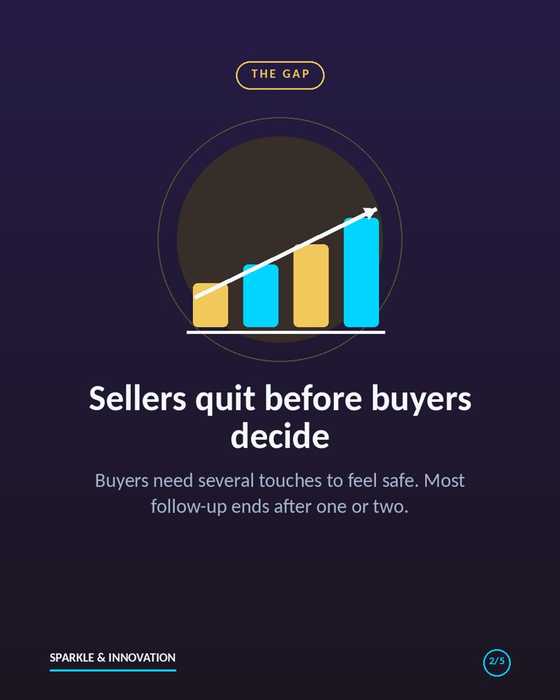
Why do sellers quit early? Three reasons show up in almost every team we work with:
- Silence is read as “no.” In reality it usually means “not this week.”
- There is no plan. Follow-up happens when someone remembers, so it stops when they get busy.
- Nobody knows what to say. The second email is hard to write, so it does not get written.
Each of these is a design problem rather than a discipline problem. Discipline runs out. Systems do not. If your cadence lives in someone’s memory instead of in your CRM, you do not have a sales follow-up strategy; you have a good intention.
Why repeated contact works: three mechanisms from the brain
1. The mere-exposure effect
Repeated, non-threatening exposure to something makes people like it more. Robert Zajonc demonstrated this in his 1968 paper on the attitudinal effects of mere exposure, and it has since been replicated with faces, words, shapes and names. Zajonc also noted the shape of the curve: liking rises with the logarithm of exposure frequency, so the early repetitions do the heaviest lifting.
For a buyer with budget at risk, familiar reads as safe, and safe is what they are shopping for. Your fourth message is not an interruption. It is the point at which you stop being a stranger.
2. Timing beats talent
The buyer’s moment of need rarely coincides with your first email. Budgets open, a competitor stumbles, a project gets approved, someone quits. A follow-up cadence is a way of being present when the need finally turns urgent. Much of what looks like persuasion is really just being there on the right Tuesday.
This is also why mapping the customer journey pays off before you write a single email. If you know roughly where a buyer sits, you can match the message to the stage instead of repeating the same pitch five times.
3. Consistency as a proof point
A seller who follows through predictably before the sale is assumed to follow through after it. The cadence itself is evidence. Buyers are evaluating your product, and at the same time they are evaluating what it will be like to work with you every week for two years. Reliable follow-up is the only preview they get. It belongs in the same category as the small signals that make a brand look professional: quiet, cheap, and decisive at the margin.
Where follow-up fails: content, not frequency
“Just checking in” is the most common follow-up line in B2B and the least effective. It asks the buyer to do the work of finding a reason to reply. It also breaks the reciprocity norm, because you are requesting attention without offering anything in exchange.
Every touch should carry one thing worth opening. Some reliable options:
- A one-paragraph case study from the buyer’s own industry, with a number in it
- A benchmark figure and one sentence on what it means for them
- A direct answer to a question they asked, or should have asked
- A short observation about a change on their website, pricing page or job postings
- A relevant article or tool, with two lines on why you thought of them
The test is simple: if the buyer never replied, would this message still have been worth their thirty seconds? If yes, send it. If no, rewrite it.
One caution on volume. Sending five options, five attachments and five questions in a single message creates the same paralysis that too many choices create on a pricing page. One idea and one ask per touch will outperform a thorough message nearly every time.
A five-touch cadence you can run this week
This is a working structure rather than a script. Adjust the spacing to your sales cycle: shorten it for transactional deals, stretch it for enterprise.
- Day 0, email. Reference the specific trigger (a call, a download, an event). One insight they can use today. Light ask: “worth a 15-minute look?”
- Day 3, LinkedIn. Connect or comment on something they published. No pitch. This is a familiarity deposit.
- Day 6, email. A short case study from their industry. One number, one sentence on how it happened. Ask a question that is easy to answer in a single line.
- Day 10, phone or voice note. Sixty seconds. Name the problem you think they have and offer one idea. Leave a way to reply in writing.
- Day 16, email. The “open door” message. Summarise the value you have shared, say you will stop for now, and give one clear next step. This message often earns the highest reply rate in the sequence, because removing the pressure makes replying cheap.
After touch five, move the contact into a low-frequency nurture: something useful every four to six weeks. The need will arrive eventually. You want to be the familiar name when it does.
The follow-up nobody plans: after the meeting
Almost every team builds a prospecting cadence and then leaves the rest to chance. Yet the most expensive silences happen later, after a good first meeting or a delivered proposal, when the deal is worth far more than a cold lead and the seller has already spent the effort to earn it.
Three touches are worth designing properly:
- Within 24 hours of a meeting. A short recap: what you heard, what you agreed, what happens next and by when. This doubles as a written record when the deal reaches someone who was not in the room.
- Three days after a proposal. Not “any thoughts?” Instead, offer to walk a specific stakeholder through the section they will care about most. Internal champions often stall because they cannot answer a finance question on your behalf.
- Two weeks after a “no” or a “not now.” Thank them, and ask one question: what would need to be true for this to be worth revisiting? The answer tells you when to return and what to bring.
A “not now” logged with a date and a reason is an asset. A “not now” that ends the conversation is a lead you paid for and then discarded.
Choosing channels: why the mix matters more than the count
Five emails is not the same as five touches. Repeating one channel trains the buyer to filter it, and a single ignored inbox can hide an otherwise interested prospect for a month. Mixing email, LinkedIn, phone and the occasional physical or video touch gives each message a fresh context and raises the chance one lands during a moment of attention.
Vary the direction as well as the medium. A touch that asks for nothing — a comment on their post, an introduction to someone useful, a note about a change in their market — costs you little and shifts the relationship out of pure transaction. It is the same logic behind gathering social proof before anyone has to go first: you are lowering the perceived risk of engaging with you, one small signal at a time.
How to measure whether it is working
Track replies by touch number, not just by campaign. Most teams discover that touches three through five out-produce touch one, which is the clearest possible argument for finishing the sequence. Three metrics are worth the reporting effort:
- Reply rate by touch number. Shows you where the sequence is actually earning its keep.
- Touch at which the meeting was booked. Compare this against where your team stops. If meetings cluster at touch four and your reps stop at two, you have found your fortune.
- Sequence completion rate. The share of prospects who receive every planned touch. This is a management number, and it is usually lower than anyone expects.
Give any change at least one full sales cycle before you judge it. Follow-up produces its results on a delay, which is precisely why it gets abandoned.
Common objections, answered
“Won’t we annoy people?” Frequency without value annoys. Value at a reasonable rhythm is welcomed, and the open-door message at the end gives every buyer a graceful exit.
“Our buyers are senior; they don’t want five emails.” Senior buyers are the most time-poor, which is exactly why a single email is unlikely to land at the right moment. Keep each touch short and specific, and they will notice the discipline.
“We don’t have content for five touches.” You have more than you think: one case study, one benchmark, one FAQ answer and one observation about their business is already four. The fifth is the open door.
“Our CRM can’t handle it.” A spreadsheet with a name, a next-touch date and a note about what you sent last will outperform an expensive tool nobody updates. Start there and upgrade once the habit holds.
The takeaway
A sales follow-up strategy is not about pushing harder. It is about matching the buyer’s timeline instead of your own patience, and making every contact a small deposit of familiarity and usefulness. Plan the touches before you send the first one, put a date on every “not now,” and measure which touch is doing the work.
The follow-up you skip is not neutral. It is the deal your competitor closes.
If you would like a second pair of eyes on your current cadence, send us your last three follow-up emails. We will tell you which touch is doing the work and which one is costing you the reply.
Related reading: How to increase online reviews and our philosophy: marketing starts with the human brain.