

A new user signs up for your free trial on a Monday. They click through a seven-step product tour, nod at a dashboard full of features, and close the tab. The next time they think about your product is day 13, when an email warns them the trial is about to end. They have not connected their data, invited a teammate or seen a single result. They do not pay, and nobody on your team ever finds out why.
That pattern is the quiet killer of SaaS trial conversion. The trial did not fail because the product was weak. It failed because the user never made progress. This guide walks through an illustrative model case, a B2B SaaS company with a 14-day trial, and shows how to turn a feature tour into a path of small, visible wins. It is not a client result. It is a blueprint you can adapt to any trial, freemium plan or onboarding period.
What Is SaaS Trial Conversion, and Why Does It Stall?
SaaS trial conversion is the share of trial users who become paying customers before or shortly after the trial ends. Most teams track it as a single percentage. That number hides the real story, which happens in the first few days.
Trials usually stall for three reasons:
- The user never reaches value. Setup takes longer than the trial, so the product never gets a chance to prove itself.
- The onboarding shows everything at once. A complete tour feels thorough to the product team and overwhelming to the user.
- Nothing marks progress. The user cannot tell whether they are 10% or 90% of the way to a working setup.
Notice that none of these are pricing problems. You can discount the first month and still lose the user who never got started. If churn after the first payment is also a worry, our guide to customer churn rate marketing covers what happens next.
The Psychology: The Progress Principle
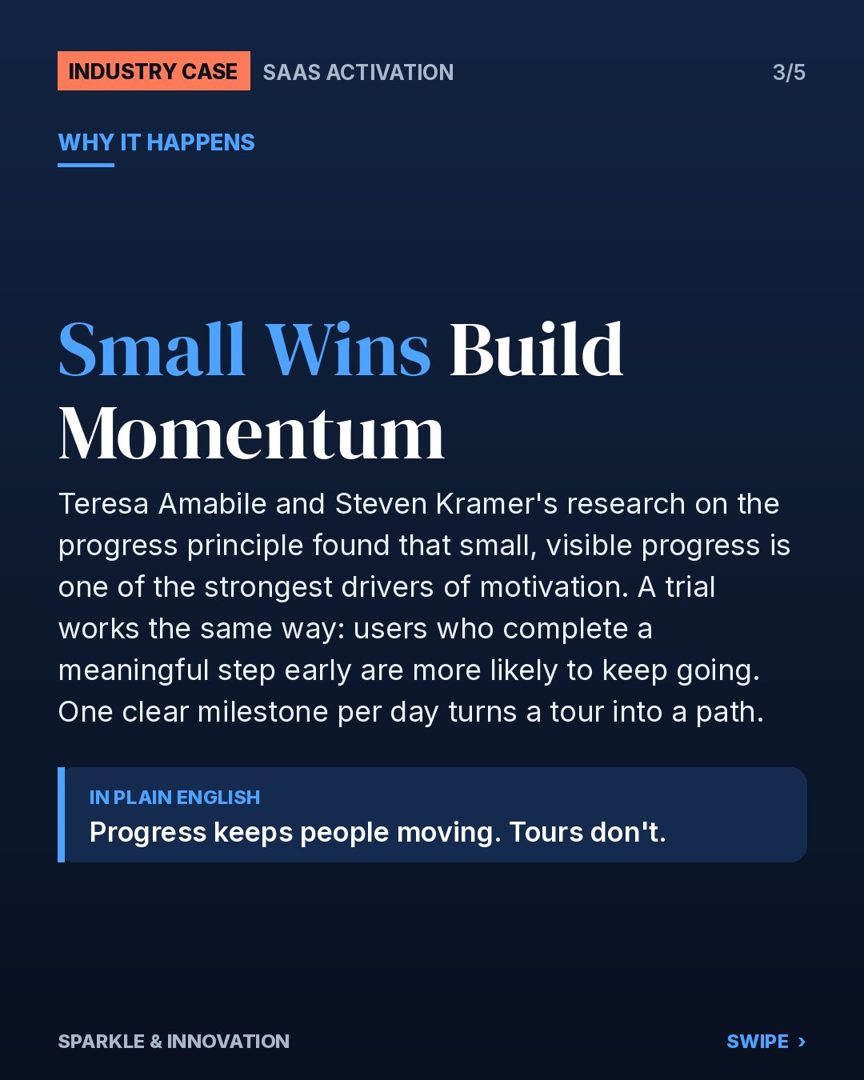
Teresa Amabile and Steven Kramer studied thousands of daily diary entries from knowledge workers. Their conclusion, published in The Power of Small Wins in Harvard Business Review, was that making steady progress on meaningful work does more than anything else to keep people motivated. Even small steps forward lifted mood and effort for the rest of the day.
A trial user is in the same position as those workers. They are deciding, day by day, whether this new tool deserves their time. Every small win is evidence that it does. Every day with no progress is evidence that it does not.
A related finding comes from loyalty research: people speed up as a goal gets closer, which psychologists call the goal-gradient effect. A progress bar that shows a user they are three steps from a working setup gives them a reason to take the next step today.
In plain English: progress keeps people moving. Tours do not.
Find the One Action That Predicts Paying
Before you redesign anything, find your activation milestone, the action that best separates users who pay from users who leave. For a reporting tool it might be connecting a first data source. For a scheduling app it might be the first booking a client makes. For a team chat tool it might be the third teammate who joins.
How to find it in practice:
- Pull the last 200 trials and split them into converted and not converted.
- List 10 to 15 actions users can take in the first week.
- Compare how often each action happened in each group, and how early.
- Pick the action with the biggest gap that also makes sense to a customer. Correlation is a starting point, not proof, so confirm it by talking to five paying customers.
Our model company, a reporting tool for agencies, found that users who connected one client account in the first three days converted far more often than those who did not. That became the north star for the whole trial.
Map One Milestone Per Day
Now work backwards from the activation milestone and give each day one job. Not five. One. Here is how the model company laid out its 14 days:
- Day 1: Create the workspace and name the first client. Two minutes, done.
- Day 2: Connect one data source, with a guided step and a human offer of help.
- Day 3: See the first auto-built report with real numbers. This is the aha moment.
- Days 4 to 7: Customize one chart, schedule one report, invite one teammate.
- Days 8 to 11: Add a second client and send a report to that client.
- Days 12 to 14: Review what was built, see the time saved, and choose a plan.
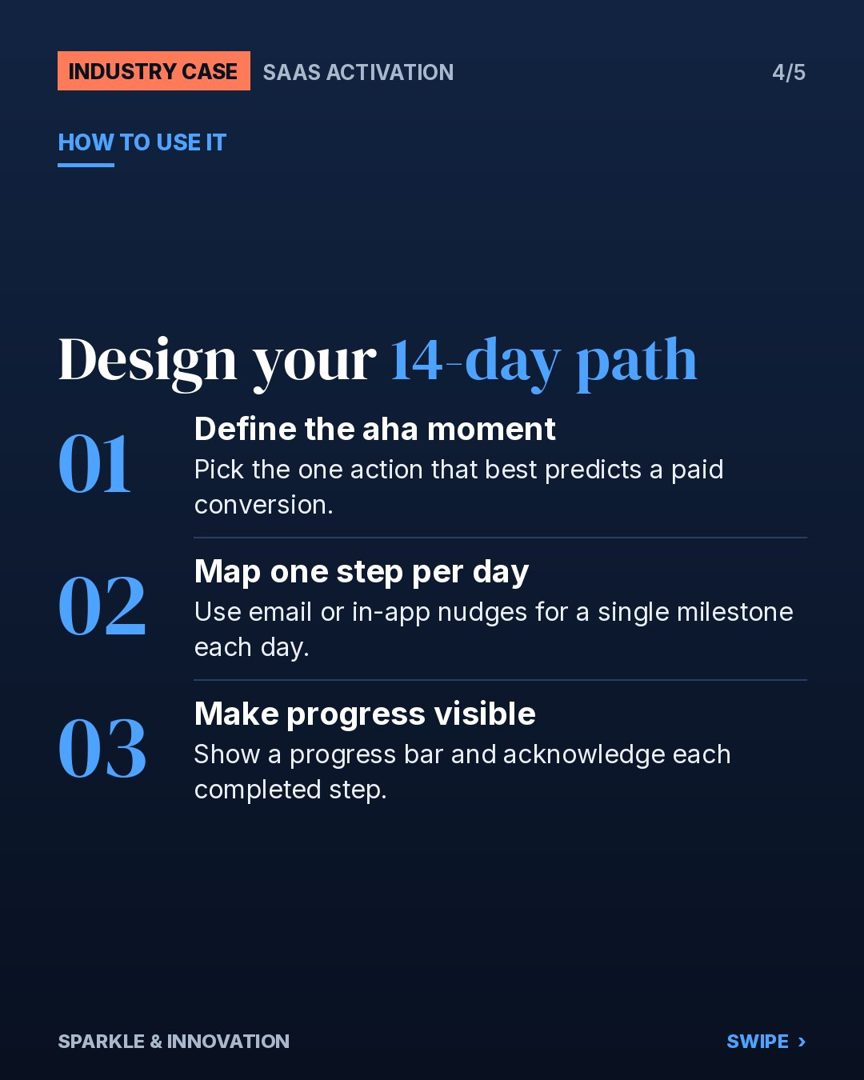
Each day’s email or in-app message asks for exactly one action and links straight to it. The feature tour does not disappear. It becomes an optional help page for users who want it.
The same logic applies to how you write those messages. A specific, curious subject line (“Your first report is 2 minutes away”) beats a generic one. Our guide to curiosity gap marketing covers how to write hooks that get opened without overpromising.
Make Progress Visible
Progress only motivates if the user can see it. Three simple tools do most of the work:
- A checklist with a progress bar on the dashboard, showing completed steps and the next one.
- A small acknowledgment each time a step is done: “Data connected. Your first report is ready.”
- A results summary near the end of the trial: reports built, hours saved, clients served.
Starting the bar at one completed step (“Account created”) also helps. Research on loyalty cards found that people finish a card faster when it arrives with a couple of stamps already filled in, because the goal feels closer from the start.
Use Humans Where the Trial Gets Stuck
Automated nudges carry most users. The ones who stall on the hardest step, usually connecting data, need a person. The model company added one rule: if a user has not connected a data source by the end of day 3, a real person sends a short, plain message offering a 10-minute call to set it up together.
That message is not a sales pitch. It is help with the exact step the user is stuck on. Users who accept the call reach the aha moment the same day, which is the whole point.
If you sell to businesses, happy trial users are also your best source of introductions. Our guide to referral programs for small business shows how to ask at the right moment.
The Catch: When Progress Nudges Backfire
The progress principle is powerful, which makes it easy to misuse. The common versions:
- Fake progress. A bar that jumps to 80% after sign-up, or celebrates steps that create no value. Users notice when the “wins” are empty, and the celebration starts to feel like manipulation.
- Nudge overload. Three emails a day plus in-app pop-ups. People stop reading, then unsubscribe, then associate your brand with noise.
- Dark-pattern endings. Requiring a card up front, auto-charging without a clear reminder, or hiding the cancel button. It may lift short-term conversion, but it creates angry customers, chargebacks and churn, and regulators in several markets are paying attention to subscription traps.
Why it backfires: progress cues work because people trust them. Once a user feels the product is steering them rather than helping them, every future message is read with suspicion.
The honest version: count only steps that create real value for the user, send one clear message per day at most, remind users before the trial ends, and make cancelling as easy as signing up. A trial that earns the sale on value keeps the customer far longer than one that wins it on friction.
How to Measure Whether It Is Working
Do not judge the new trial by conversion rate alone. Track a small set of leading indicators:
- Time to activation: how many hours or days until users hit the key milestone.
- Activation rate: the share of trial users who reach it at all.
- Trial-to-paid conversion: the outcome you care about.
- Early retention: how many new customers are still active 90 days after paying.
If activation rises but conversion does not, your milestone may be the wrong one. If conversion rises but 90-day retention drops, you may be pushing people who were never a fit. Both are signals to adjust, not to stop.
Frequently Asked Questions
What is a good SaaS trial conversion rate?
It varies widely by price point, market and whether a card is required up front, so benchmarks from other companies are only a rough guide. The more useful comparison is your own rate before and after you redesign the trial, measured over a few hundred trials.
Should a free trial be 7, 14 or 30 days?
Long enough for a typical user to reach the activation milestone, and no longer. If most converting users activate in three days, a 30-day trial mostly gives people more time to forget about you.
Is a progress bar enough on its own?
No. A progress bar shows the path, but the path has to lead somewhere real. Pair it with one clear daily step and a human offer of help at the hardest point.
Key Takeaway
SaaS trial conversion is won in the first few days, one small win at a time. Find the action that predicts paying, give every day one clear job, make progress visible, and step in personally where users get stuck. Do it honestly, with real milestones and an easy exit, and the trial does the selling for you.
Want Help Designing Your Trial Journey?
If your trials are getting sign-ups but not sales, we can help you map the path. Contact Sparkle & Innovation and ask for a free 15-minute marketing audit, or DM us “AUDIT” on Instagram.