
How to define your target audience is the question most founders answer with a shrug and the phrase “anyone who will pay.” It sounds pragmatic. It is the single most expensive sentence in small-business marketing, because a message written for everyone is processed by the buyer’s brain as a message for no one. This article explains why that happens neurologically, how to spot it in your own copy, and a one-session method for narrowing the audience without losing the customers you are afraid of leaving behind.
Why “everyone” is a brain problem, not a strategy problem
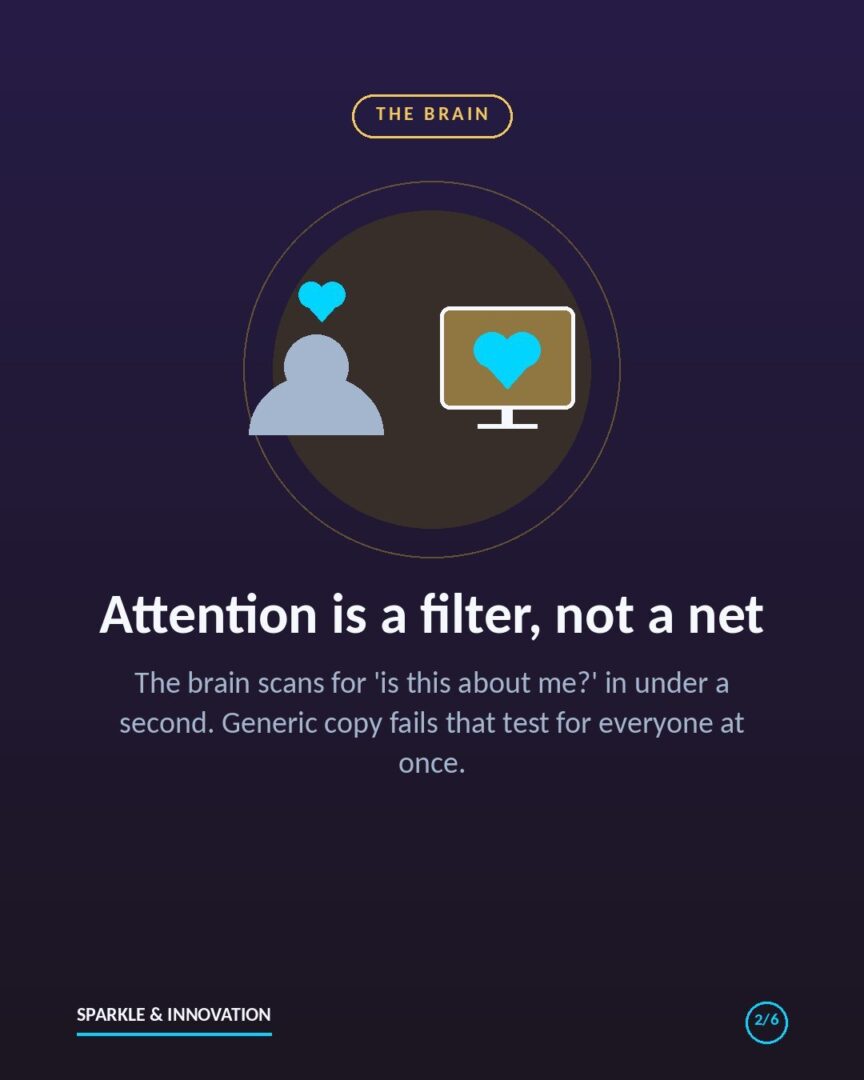
Every piece of marketing passes through the same gate before it is read: the buyer’s attention system asks one question, “is this about me?”, and answers it in well under a second. Neuroscientists describe attention as a filter rather than a net. It does not gather everything and sort later. It discards almost everything immediately and admits only what matches an active goal, a recognized threat, or a familiar cue.
Generic copy fails that filter for every reader simultaneously. “Solutions for businesses of all sizes” contains no cue that any specific reader can match against their own situation. The dental practice owner sees nothing about dentistry. The logistics manager sees nothing about freight. The sentence is not wrong. It is invisible.
This is why targeting is not a segmentation exercise you complete in a spreadsheet and file away. It is the input that determines whether the brain lets your message in at all. The same principle underlies why social proof works only when the proof comes from people like the reader: relevance is what the attention system is scanning for.
The tell: could your headline sit on a competitor’s site?
There is a five-second test for whether you have defined a target audience or merely described a market. Open your homepage. Cover the logo. Read the headline and first paragraph. Now ask whether the same words could be pasted onto the site of your three closest competitors without anyone noticing.
If the answer is yes, you have not told the buyer why you exist. You have told them what category you are in, which they already knew when they searched. Recommendation systems have the same problem. Search engines, social feeds and AI assistants all need consistent signals about who a business serves in order to show it to the right people. A site that serves “everyone” gives them nothing to work with.
The fear behind broad targeting, and why it is backwards
Founders resist narrowing for a rational-sounding reason: narrowing feels like leaving money on the table. If we say we serve dental practices, will the veterinary clinic still call?
In practice the opposite happens. Specific messaging attracts adjacent buyers who recognize the pain even when the details differ. A landscaper whose site talks about “seasonal care contracts for HOA boards” gets read by property managers and facilities directors, because the situation is recognizable. The reverse never works. Generic copy does not pull in the specific buyer, because there is nothing for that buyer to recognize.
The research on choice overload points the same direction. When a buyer cannot tell what you are for, they do not choose you cautiously. They do not choose at all.
How to define your target audience in one working session
The method below takes about ninety minutes with two or three people who talk to customers. It produces a one-page profile that every piece of copy can be tested against. It has four questions. Resist the urge to answer them with categories; answer them with specifics.
1. Who: one role, one industry, one size
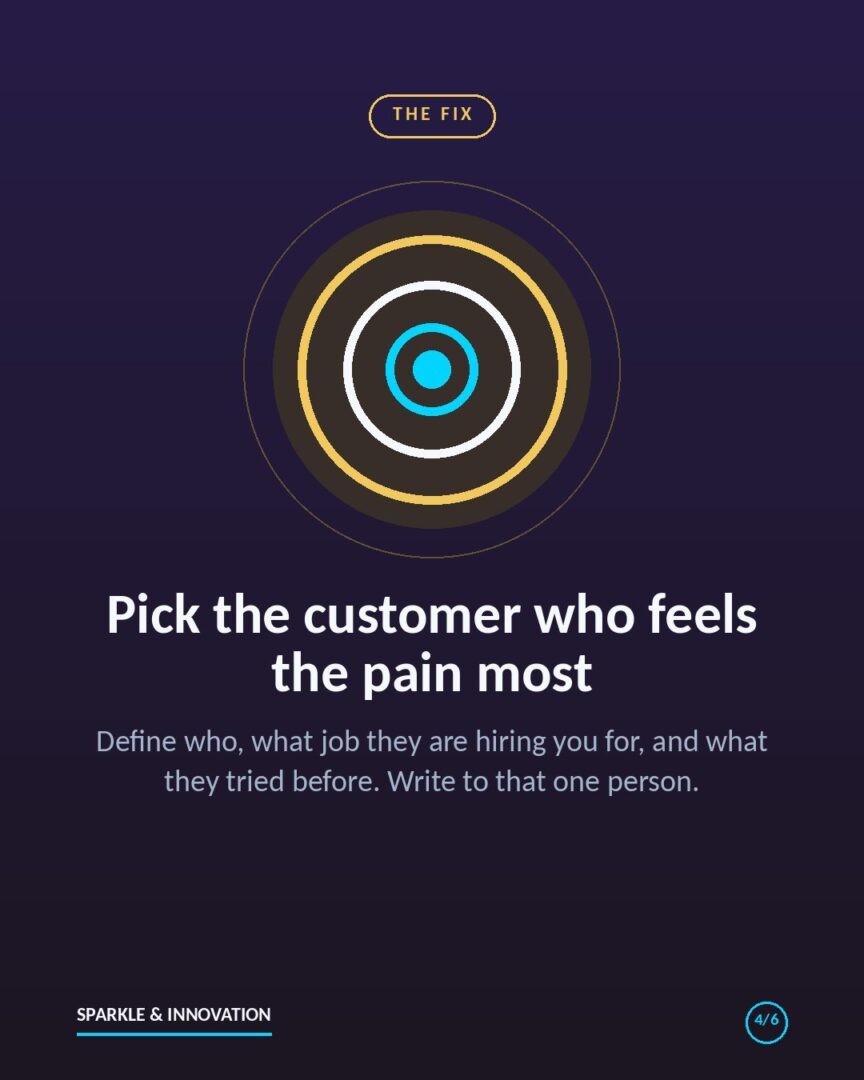
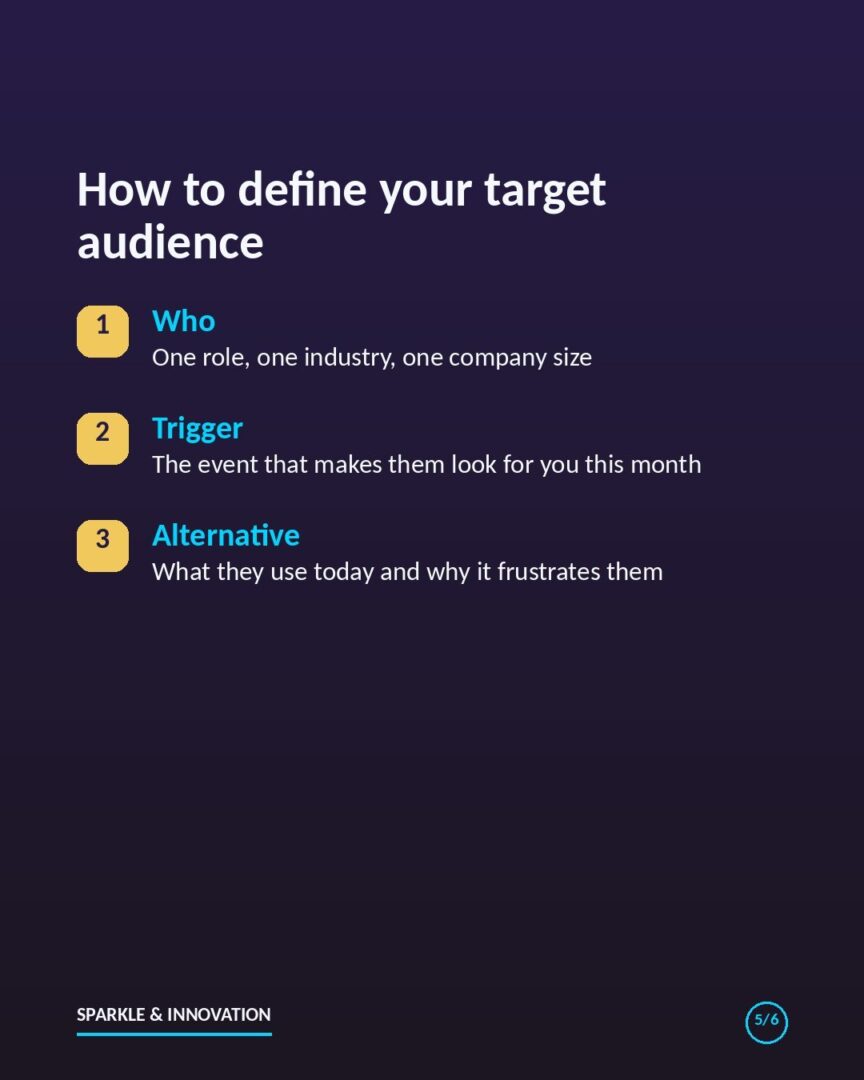
“Healthcare businesses” is a category. “Owners of five to twenty person dental practices who handle their own marketing” is a target. The difference is that the second version describes a person who can recognize themselves in a sentence. Write down the role that signs the check, the industry they operate in, and the size of company where your offer fits best. If you serve several, pick the one where you have the strongest results and the most referrals. You can add a second profile later. You cannot write a headline for two at once.
2. Trigger: the event that makes them look for you this month
Audiences do not buy on a schedule. They buy when something happens. A new location opens. A key employee leaves. A run of bad reviews lands. A competitor moves in across the street. A lender asks for a plan. Triggers turn a static profile into a moment you can write to, and they tell you where the buyer will be looking when the moment arrives. This is the “job to be done” framing that Clayton Christensen described in his Harvard Business Review piece on knowing your customers’ jobs: people hire a product to make progress in a specific circumstance, and the circumstance matters more than the demographic.
3. Alternative: what they use today and why it frustrates them
Nobody switches from nothing. Your buyer already has a way of handling the problem: a spreadsheet, a cousin who does websites, an agency they are quietly unhappy with, or the decision to ignore it. Your differentiation lives in the gap between that alternative and what you do. Write down the alternative in the buyer’s own words, and write down the specific frustration. “Our agency reports on impressions and we cannot tell if any of it turns into patients” is a sentence you can build a homepage around.
4. Cost of the problem: what it costs them not to solve it
Quantify the trigger. An empty appointment slot costs a dental practice a known amount. A month of vacancy on a rental unit costs a known amount. A lost hygienist costs a known amount in re-hiring and lost production. You will use this number twice: once to decide whether the audience can afford you, and once in your copy, where it becomes the proof of value that justifies the price. This connects directly to the economics of acquisition versus retention, because a well-defined audience is cheaper to reach and cheaper to keep.
Turning the profile into copy
Once the four answers exist, rewrite one asset. Not the whole site. The homepage headline and the first paragraph, or the opening of your most-sent proposal. Use the following structure as a starting point rather than a template:
- Name the person and the trigger. “For dental practice owners who just lost a hygienist and cannot fill the chair.”
- Name the alternative and its frustration. “Job boards bring applicants who ghost the interview.”
- Name the outcome, in their terms. “A hiring pipeline that produces three qualified candidates in fourteen days.”
- Name the cost of waiting. “Every empty hygiene day is roughly $1,400 in lost production.”
Read it aloud to someone who matches the profile, not to your team. Your team will tell you it is too narrow. The buyer will tell you whether it is about them. Only the second opinion matters.
What changes when the audience is defined
Three things happen fairly quickly. First, your content gets easier to write, because every topic now has an obvious reader and an obvious angle. Second, your paid advertising gets cheaper, because the platforms can match a specific message to a specific audience more efficiently than they can spray a generic one. Third, referrals increase, because a business that is easy to describe is easy to recommend. “They help dental practices fill hygiene chairs” travels. “They do marketing” does not.
There is a longer-term effect too. A brand that consistently speaks to one audience builds distinctive memory structures in that audience, which is the foundation of the compounding growth that marketing and SEO deliver together. Broad brands rent attention. Specific brands earn recall.
Common objections, answered briefly
“Our product genuinely works for many industries.” It probably does. Your marketing still needs a front door. Pick the industry where you have the best proof and lead with it. Other industries will find you through that door, and you can add doors later.
“We will offend the customers we do not name.” Customers are not offended by specificity. They are indifferent to generality. A veterinary clinic reading a dental-focused page thinks “this is for dentists, but the problem is the same,” and calls anyway if the pain is real.
“We tried a niche once and it was too small.” Then the niche was defined by a category, not a trigger. A trigger-based audience is usually larger than it looks, because triggers recur across many businesses every month.
The takeaway
Targeting everyone is not a strategy. It is the absence of one, dressed up as ambition. The buyer’s brain admits only what it recognizes as relevant, and relevance requires a specific person, a specific moment, and a specific frustration. Define those three, write to that one person, and adjacent buyers will follow. Write to everyone, and the filter closes before your sentence ends.
If you want a second pair of eyes on your own profile, send us the four answers. We will tell you honestly whether a stranger in that role would recognize themselves in your headline, and what to change if they would not.